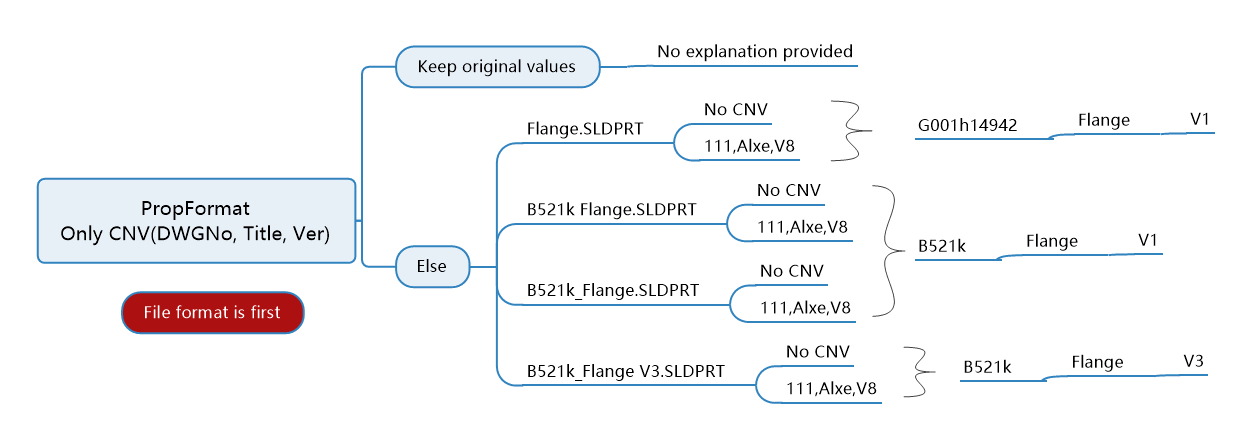
Document differentiation and avoidance: No avoidance
Attribute formatting is equivalent to directly inputting the 22 standard attributes preset by TDO into all configuration-specific attributes of the component. Attribute formatting has the same function as formatting in the Attribute Manager. However, because the Attribute Manager has path batch processing capabilities in addition to assembly batch processing, we recommend using attribute formatting as the starting point for SWTDO.
Design throughout all stages, with automatic completion
Scenario: During the design and drafting process, some parts have attribute values added, such as material, which is specified as Q235, but many parts are not specified. Attribute formatting does not destroy your original assignments. No matter which design stage you are in, attribute formatting can be balanced, that is, it can retain your original attribute values while also allowing for the addition of new attributes. It depends on your choice of formatting method.
coverage
All configurations with specific properites
Combination Techniques
The number-issuing system determines the file differentiation format.
PropFormat + SmartRename
PropFormat + PropManager
PropFormat + sheet metal
PropFormat + welding
What basic properties have been added through PropFormat ?
Depending on your settings for Prod, if you set 10 attributes, there will be 10 additional attribute formatters; if you set 50, there will be 50 additional. SWTDO has a default of 30 additional attributes.
Sheet metal and welding are automatically recognized (with "Yes" or "No" formatted for attributes).
Enabling attribute formatting will bring up a pop-up window asking whether to keep the original attributes.
“Yes”: The speed will be very slow, and it will simultaneously extract custom attributes to the specific configuration.
“No”: Faster
For sheet metal parts and weldments, only by using “No” can they possess self-recognition ability, and the recognition results can be directly entered into the “File Differentiation” attribute